
Learning from incidents, accidents and events
Learning from incidents (LFI) is a process whereby employees and organisations seek to understand any negative events that have taken place and then take actions in order to prevent similar events from happening again. Developing an effective process for LFI will provide an organisation with a critical tool for managing its risks. Inadequate LFI processes have been cited as contributory factors in major accidents such as the space shuttle accidents, Piper Alpha, Macondo and many others. An effective LFI process will use multiple opportunities for learning to optimise changes that lead to a lower risk, more stable, business environment.

Price: Free
ISBN: 9781787255333
Version: 1st (March 2026)
The Reporting, investigating, and learning from incidents, accidents and events publication covers the full incident investigation and learning from incidents (LFI) process, from reporting and prioritisation through to investigation, learning, action planning, and implementing change. As a comprehensive resource, it provides good practice guidance across all key stages of the lifecycle, with a strong emphasis on understanding underlying causes, including human and organisational factors, and on embedding a learning culture rather than one of blame. It also highlights the importance of effective sharing, thematic analysis, and follow-up to ensure learning is applied and sustained.
Further resources
The Energy Institute and other organisations publish lots of useful information on learning from incidents. The below resources have been mapped to the 'learning from incidents lifecycle' (those available from the Energy Institute are shown in the image as examples).
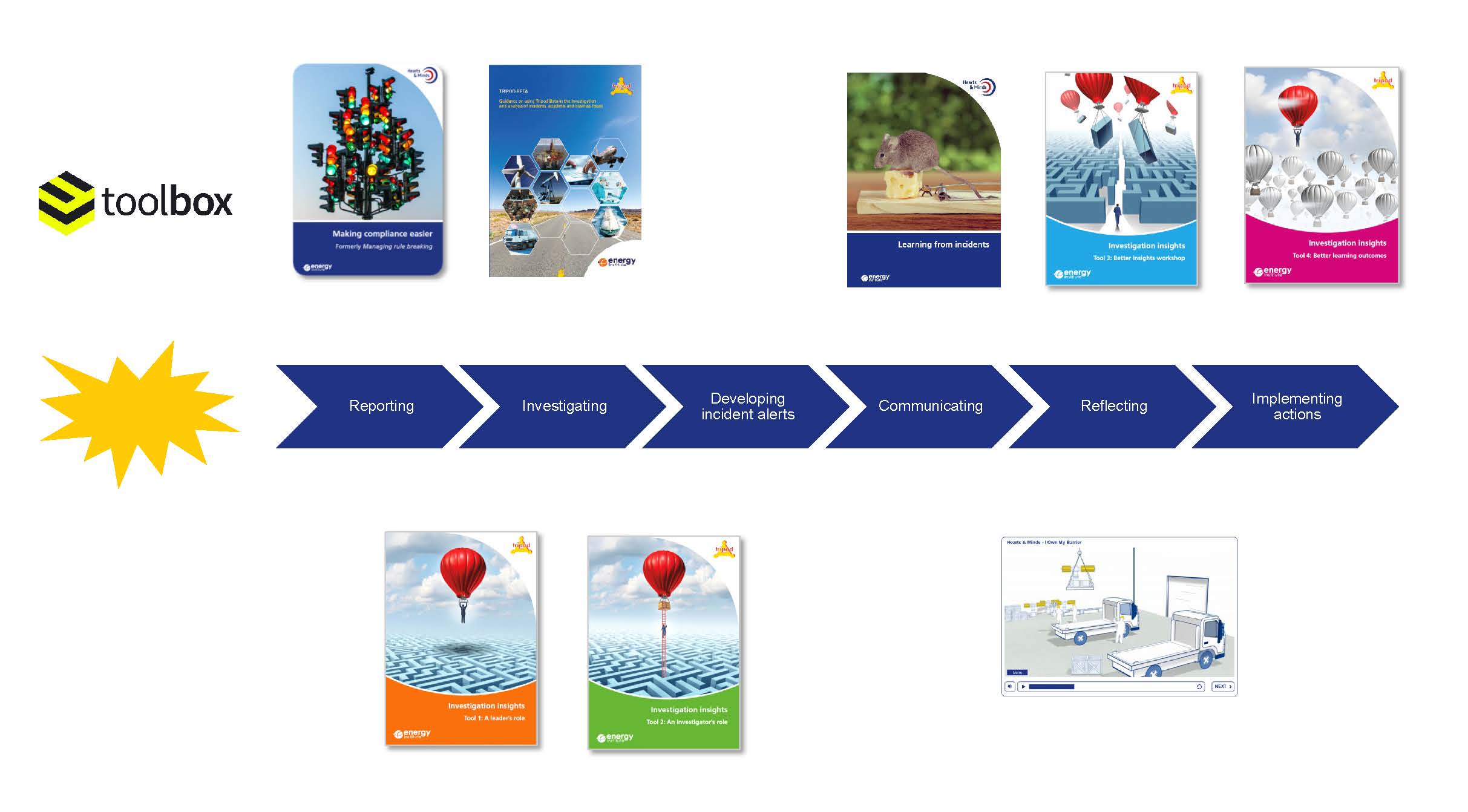
General information (including organisational learning)
The following resources cover general information about learning (from incidents or from normal work):
- - Energy Institute, Reporting, investigating, and learning from incidents, accidents and events: sets out good practice guidance spanning the full incident investigation and learning lifecycle, offering a high-level reference rather than detailed instruction on individual elements.
- - Energy Institute, Hearts and Minds, Learning from incidents: provides information on the LFI lifecycle, and exercises to help leadership understand what activities they have in each stage of the lifecycle.
- - IOGP 552 - Components of Organizational Learning From Events: provides a framework and high level guidance of the things organisations should have in place to enable organisational learning, including intent, tools, processes, and people.
- - CCPS, Driving Continuous Process Safety Improvement From Investigated Incidents: This book offers guidelines for improving process safety performance by embedding the lessons learned from publicly available investigations, recommends a continuous improvement learning model focused on organizational learning, and provides examples for using the model’s techniques to drive continuous improvements.
- - CCPS - Recognizing Catastrophic Incident Warning Signs in the Process Industries: This book provides guidance on characterizing, recognizing, and responding to warning signs to help avoid process incidents and injuries before they occur.
An incident occurs...
These resources include databases of incidents (incident alerts etc.), and guidance on incident response:
- - Toolbox: a free web-app sharing lessons learned with frontline workers. Contains over 500 high quality incident alerts, including videos, suitable for sharing with teams, in 10 languages. All are good examples of incident alerts.
- - CCPS, More Incidents That Define Process Safety - provides information on dozens of process safety incidents, covering fires, chemical hazards and other process safety hazards.
- - Energy Institute, Investigation insights - Tool 1: A leader’s role: this tools focuses on how leaders respond to incidents, including in the aftermath, but also in setting the investigation up for success.
Reporting
Reporting of incidents is necessary for them to be learned from. The following resources include guidance on creating a ‘psychologically safe’ environment where people can freely report incidents, and ways to capture information in reporting systems:
- - Energy Institute, Hearts and Minds, Making compliance easier: includes information on creating a psychologically safe environment, and guidance on ‘consequence management’ and how leaders and HR should respond to incidents.
Investigation
During investigations, incidents and other events such as near misses are analysed, and the various causes identified – including failed barriers, human actions (mistakes and non-compliances), performance influencing factors/preconditions and underlying causes. In short, the investigation finds out what happened, how it happened and why it happened. The following resources include investigation methodologies and guidance for investigators and others involved in the investigation:
- - Energy Institute, Tripod Beta: A robust methodology for analysing incidents, identifying failed barriers and underlying causes. Includes a user guide, training courses and an accreditation scheme.
- - Energy Institute, Investigation insights - Tool 1: A leader’s role: this tools focuses on how leaders respond to incidents, including in the aftermath, but also in setting the investigation up for success.
- - Energy Institute, Investigation insights - Tool 2: An investigator’s role: this tool focuses on how investigators can set up the investigation for success, and how they can 'take leaders with them' during the investigation.
- - Energy Institute, Human factors briefing note no. 15 – Incident and accident analysis: provides a 4 page introduction to human factors in incident investigation.
- - IOGP 621 - Demystifying Human Factors: Building confidence in human factors investigation: provides an overview of how human factors should be considered during an investigation, including lots of practical guidance for how the investigation should be carried out.
- - CCPS, Guidelines for Investigating Process Safety Incidents: This book provides a comprehensive treatment of investigating chemical processing incidents. It presents on-the-job information, techniques, and examples that support successful investigations.
Developing incident alerts
‘Incident alerts’ are usually short one-page documents, videos or other learning materials that can be shared with people following an incident investigation. The following resources are good examples of incident alerts, and guidance on how to create incident alerts:
- - Toolbox: a free web-app sharing lessons learned with frontline workers. Contains over 500 high quality incident alerts, including videos, suitable for sharing with teams, in 10 languages. All are good examples of incident alerts.
- - Energy Institute, Hearts and Minds, Learning from incidents: provides exercises to help you create engaging incidents alerts.
Communication
It is critical to communicate lessons learned from incidents with the right people and in the right way. The following resources can help:
- - Energy Institute, Hearts and Minds, Learning from incidents: provides exercises to help you understand who lessons learned need to be communicated with, and how.
Reflective learning
Adults learn through ‘reflective learning’. This means that people need to be given the time and space to really make sense of an incident alert, and reflect on what it means to them and their job. The following resources include more information on what reflective learning is, and examples of reflective learning materials:
- - Energy Institute, Hearts and Minds, Learning from incidents: includes exercises to help do reflective learning sessions with teams.
- Video: Energy Institute, Reflective learning: this short video introduces the concept of reflective learning, and tips on how to do it.
- - Energy Institute, Reflective learning videos: 9 videos on topics including barrier management, line of fire, dropped objects and contract management. Each video includes a facilitator guide. These are good examples of reflective learning materials.
- - Toolbox: a free web-app sharing lessons learned with frontline workers. Contains over 500 high quality incident alerts, including videos, suitable for sharing with teams, in 10 languages. Every incident alert includes reflective learning questions (‘Ask yourself or your team’).
- - Energy Institute, Investigation insights - Tool 3: Better insights: a robust workshop exercise to help leaders and other understand an incident, its causes, the role they played, and improve recommendations.
Implementing actions and measuring outcomes
Learning can only be said to have taken place is there is a change in processes, documentation, behaviours etc. The following resources can help implement actions from investigations, and measure effectiveness:
- - Energy Institute, Investigation insights - Tool 4: Better learning outcomes: contains a process and 6 exercises to help teams implement incident investigation recommendations.
- - Video: Energy institute, Measuring learning: this is a free workshop exercise, including a video and guidance note. The workshop helps leaders think about what are the indicators of learning (‘hard’ indicators and ‘soft’ indicators), what data are they collecting, how is it used and what it tells you about whether the organisation is learning.
- - Video: Learning before Incidents: a free video on what we can learn from understanding variation in performance.